
What Is an API?
An API (Application Programming Interface) is a set of rules and protocols that allows different software applications to communicate with each other.
Instead of exposing its internal implementation, an application exposes an API that defines how other applications can send requests and receive responses. This enables software systems to exchange data and functionality in a secure and standardized manner.
Simply put, an API acts as a communication bridge between two applications.
Real-World Example
Imagine you are using a weather application on your mobile phone.
- The mobile app sends a request to the weather service API.
- The API communicates with the weather server.
- The server returns the latest weather information.
- The API sends that response back to the application.
- Finally, the weather app displays the information to you.
Without the API, the application would not know how to communicate with the weather service.
Interview Answer
An API is a communication interface that enables two software applications to exchange information using predefined rules. It accepts requests, processes them, and returns responses without exposing the application's internal implementation.
What Is API Testing?
API Testing is a type of software testing that validates whether an API functions correctly and meets functional, performance, reliability, and security requirements.
Unlike UI testing, API testing focuses directly on the backend by sending requests to API endpoints and validating the responses.
API testing verifies:
- Request processing
- Response data
- Status codes
- Response time
- Authentication
- Authorization
- Error handling
- Business logic
Example
Suppose an API returns employee details.
Request
GET /employees/101Expected response:
{
  "id":101,
  "name":"John",
  "department":"QA"
}
The tester validates:
- Status code is 200 OK
- Response contains correct employee details
- Response format is valid JSON
- Response time is within the acceptable limit
Why API Testing Is Important
Modern applications are built using microservices and distributed systems, where multiple services communicate through APIs.
If an API fails, several applications depending on it may also stop working.
API testing helps identify defects much earlier than UI testing.
Benefits of API Testing
- Detects backend issues before UI development
- Faster than UI automation
- Improves application stability
- Validates business logic independently
- Ensures secure communication
- Reduces overall testing cost
- Supports continuous integration and continuous delivery (CI/CD)
Real-Time Project Example
In one project, the frontend application was still under development while backend APIs were already available.
The QA team validated every API independently by checking:
- Status codes
- Response body
- Authentication
- Error messages
- Performance
By the time the UI was ready, most backend defects had already been fixed, making integration much smoother.
Interview Answer
API testing allows us to validate backend functionality before the UI is developed. It helps detect defects early, improves application quality, supports automation, and ensures reliable communication between services.
Types of APIs
APIs can be classified based on architecture and access level.
Types of APIs Based on Architecture
REST API
REST (Representational State Transfer) is the most widely used API architecture.
Characteristics:
- Uses HTTP protocol
- Supports JSON and XML
- Lightweight
- Stateless
- Easy to develop and maintain
Example:
GET https://api.example.com/users/101SOAP API
SOAP (Simple Object Access Protocol) is a protocol commonly used in enterprise applications.
Characteristics:
- XML-based
- Strict messaging format
- Built-in security standards (WS-Security)
- Supports WS-Security
- Used in banking and financial applications
GraphQL API
GraphQL allows clients to request only the required data instead of receiving the entire response.
Advantages:
- Reduces unnecessary data transfer
- Single endpoint
- Flexible queries
- Better performance for mobile applications
WebSocket API
WebSocket APIs enable two-way communication between the client and server.
Common use cases:
- Chat applications
- Live notifications
- Online gaming
- Stock market applications
gRPC API
gRPC (Google Remote Procedure Call) is a high-performance framework developed by Google.
Features:
- Uses Protocol Buffers
- Fast communication
- Binary serialization
- Commonly used in microservices
Types of APIs Based on Access
Open (Public) API
Available for anyone to use.
Example:
- Weather APIs
- Google Maps APIs
Partner API
Accessible only to approved business partners.
Example:
- Payment gateway integrations
- Shipping provider APIs
Internal (Private) API
Used only within an organization.
Example:
- HR Management System APIs
- Internal Employee APIs
Composite API
Combines multiple API requests into a single request.
Useful when one request depends on data from multiple services.
REST vs SOAP APIs
| Feature | REST | SOAP |
|---|---|---|
| Type | Architectural Style | Protocol |
| Data Format | JSON, XML, Text | XML Only |
| Performance | Faster | Slower |
| Message Size | Lightweight | Heavy |
| State | Stateless | Supports Stateful Operations |
| Learning Curve | Easy | Complex |
| Security | HTTPS, OAuth, JWT | WS-Security |
| Best For | Web Applications, Mobile Apps, Microservices | Banking, Finance, Enterprise Applications |
REST Advantages
- Lightweight
- Faster
- Easy to develop
- Better scalability
- JSON support
SOAP Advantages
- Strong security
- Standardized messaging
- Reliable transactions
- Enterprise support
Interview Answer
REST is a lightweight architectural style that commonly uses JSON and HTTP methods, while SOAP is a protocol that uses XML with strict standards and advanced security features. REST is preferred for modern web services, whereas SOAP is widely used in enterprise and banking applications. You may also find Top 30 API Testing Interview Questions & Answers useful.
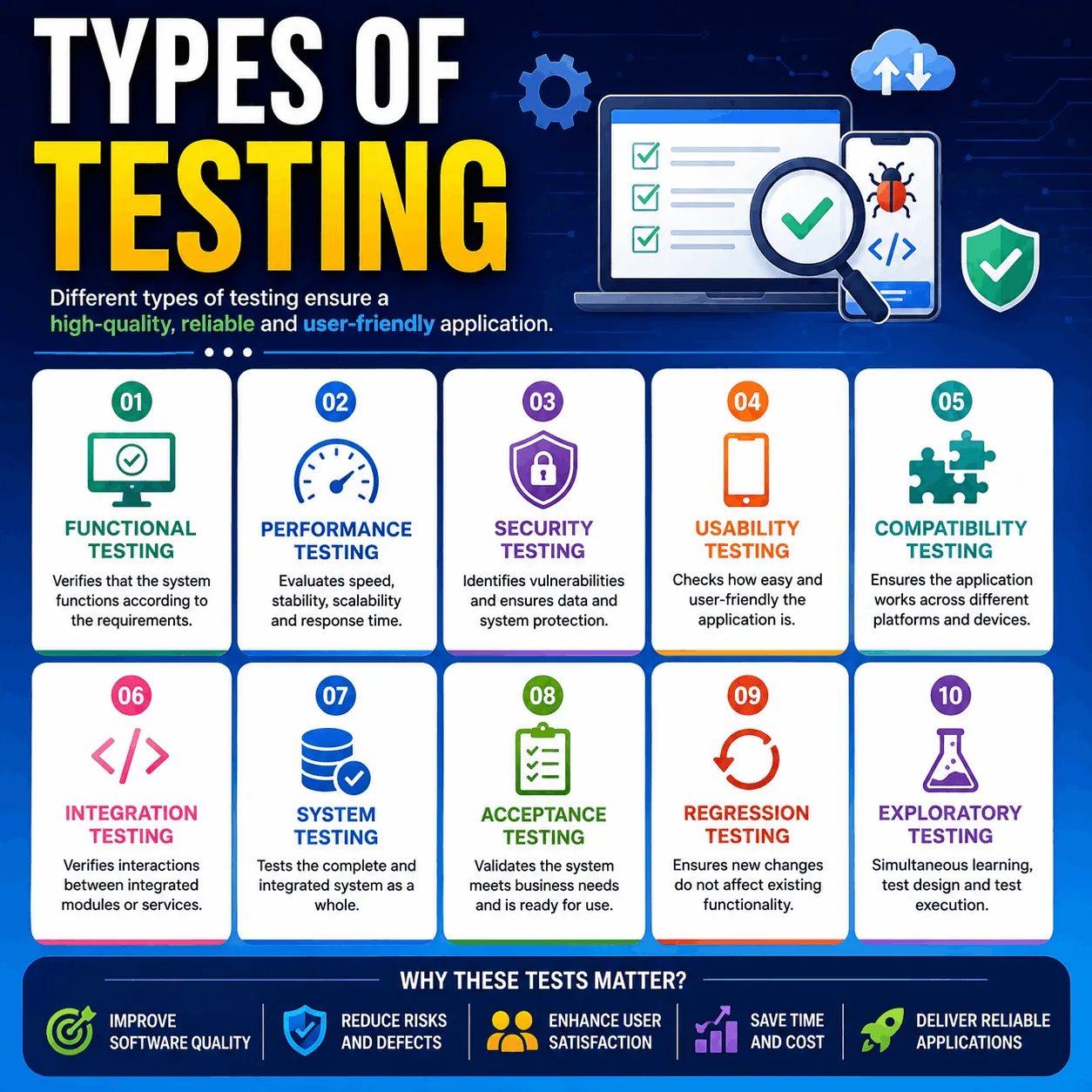
Types of API Testing
Different types of API testing ensure that APIs work correctly under different scenarios.
Functional Testing
Verifies whether the API behaves according to business requirements.
Example:
- GET request returns correct employee details.
Validation Testing
Ensures that the API response structure, schema, and data are correct.
Checks include:
- JSON format
- Required fields
- Data types
- Response schema
Load Testing
Measures API behavior under expected user load.
Example:
- 1,000 concurrent users accessing the same endpoint.
Performance Testing
Measures:
- Response time
- Throughput
- Server utilization
- Scalability
Security Testing
Ensures APIs are protected against unauthorized access.
Tests include:
- Authentication
- Authorization
- Token validation
- SQL Injection
- Cross-Site Scripting (XSS)
Integration Testing
Verifies communication between multiple APIs and services.
Example:
- Order API
- Payment API
- Inventory API
Penetration Testing
Simulates cyberattacks to identify security vulnerabilities before attackers do.
Regression Testing
Ensures new code changes do not affect existing API functionality.
Usually automated using Postman, Rest Assured, or CI/CD pipelines.
Unit Testing
Tests individual API methods or components in isolation.
Usually performed by developers.
End-to-End Testing
Validates complete business workflows involving multiple APIs.
Example:
Customer Registration → Login → Add Product → Payment → Order Confirmation
API Testing vs UI Testing
| Aspect | API testing | UI testing |
|---|---|---|
| What it tests | Business logic and data at the service layer | User journeys through the screens |
| Speed | Milliseconds per test | Seconds per test |
| Stability | High — not affected by layout changes | Lower — breaks when the UI changes |
| When it can start | As soon as the API exists | Only after the UI is built |
| Error cases | Easy to reach (invalid payloads, missing auth) | Often hard to trigger |
| Best for | Most functional and regression checks | Critical end-to-end user flows |
Most teams keep the majority of automated checks at the API level and a smaller set of UI tests on top.
What to Validate in Every API Test
- Status code — the exact expected code, e.g. 201 rather than "any 2xx". See the HTTP Status Codes Cheat Sheet.
- Response body — correct values, not only that fields exist.
- Schema — field names, data types and required fields.
- Headers — content type and security headers.
- Response time — within the agreed limit.
- Error handling — clear messages, no stack traces or internal details.
- Side effects — the data was really saved, updated or deleted.
- Authorization — each role can do only what it should.
Practice designing test cases for real endpoints in the API Testing Scenario Lab, and learn the building blocks next: HTTP Methods & Status Codes and Requests & Responses. The full path is in The Complete API Testing Tutorial.
Why Postman Is Used for API Testing
Postman is one of the most popular API testing tools used by developers and QA engineers to test REST and SOAP APIs without writing complex code.
It provides a graphical interface to create requests, validate responses, automate test cases, and manage API collections.
Advantages of Postman
- Easy-to-use graphical interface
- Supports GET, POST, PUT, DELETE, and PATCH methods
- Supports REST and SOAP APIs
- Environment variables
- Collection Runner
- Newman for command-line execution
- Authentication support
- Automated test scripts
- Mock servers
- API documentation generation
- CI/CD integration
How to Test an API Using Postman
- Open Postman.
- Create a new request.
- Enter the API endpoint.
- Select the HTTP method.
- Add request headers if required.
- Add the request body for POST or PUT requests.
- Click Send.
- Validate:
- Status code
- Response body
- Headers
- Response time
- Add test scripts for automated validation.
- Save the request to a collection.
Interview Answer
We use Postman because it provides an easy interface for testing APIs, validating responses, automating test cases, managing environments, and integrating API testing into CI/CD pipelines using Newman.
Frequently Asked Questions
What is an API?
An API (Application Programming Interface) is a communication interface that enables different software applications to exchange data and functionality through predefined requests and responses.
What is API testing?
API testing is a software testing technique that validates the functionality, reliability, performance, and security of APIs by sending requests directly to API endpoints and verifying their responses.
Why is API testing important?
API testing helps identify backend issues early, improves software quality, speeds up testing, supports automation, and ensures reliable communication between different services.
What are the different types of APIs?
Based on architecture:
- REST
- SOAP
- GraphQL
- WebSocket
- gRPC
Based on access:
- Open APIs
- Partner APIs
- Internal APIs
- Composite APIs
What is the difference between REST and SOAP?
REST is a lightweight architectural style that commonly uses JSON and HTTP methods, while SOAP is a protocol that uses XML with strict standards and enhanced security features.
What are the different types of API testing?
Common API testing types include:
- Functional Testing
- Validation Testing
- Load Testing
- Performance Testing
- Security Testing
- Integration Testing
- Penetration Testing
- Regression Testing
- Unit Testing
- End-to-End Testing
Why is Postman widely used?
Postman simplifies API testing by allowing testers to send requests, validate responses, automate test cases, manage environments, and integrate testing into CI/CD pipelines.